Reference specification.
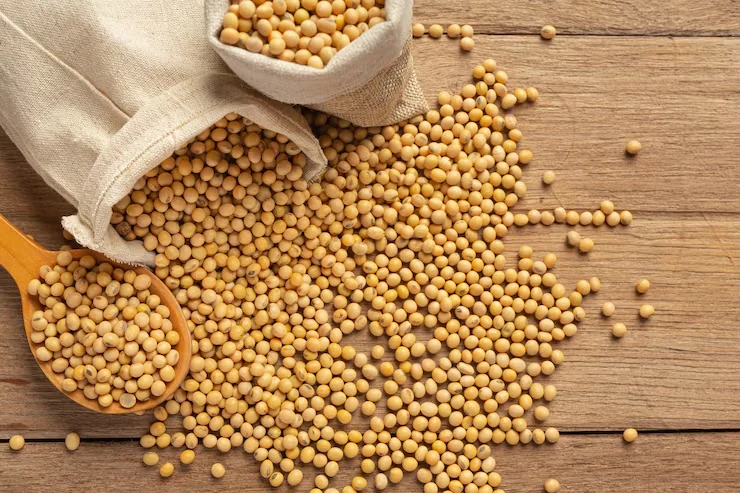
Whole soybeans
One of the most liquid commodities in international trade, with widely standardized contracts and specifications.
Export standard, non-GMO or conventional, as per contract.
- Moisture
- ≤ 14,0%
- Foreign matter
- ≤ 1,0%
- Damaged beans
- ≤ 8,0%
- Green beans
- ≤ 8,0%
- Protein content
- ≥ 36% (dry basis)
- Classification
- Export standard, non-GMO or conventional as per contract
Comparative profile
Comparative index across the products in this line.
It does not replace laboratory analysis.
Typical applications
- Crushing and oil production
- Animal nutrition
- Food industry (plant protein)
- International trading and resale
Available packaging
- Bulk (bulk carrier)
- 1,000 kg big bag
- 20' or 40' container
All parameters in this sheet are reference values for commercial quotation, confirmed by a Certificate of Analysis (COA) or sanitary report issued for each lot at shipment.
The rhythm of soybeans.
Mato Grosso, Paraná, Rio Grande do Sul and Goiás account for most of the production.
The harvest period runs from September to February, with peak availability between March and June.
What you want to know.
Where do the soybeans come from?
Brazilian whole soybeans, sourced from the Center-West and South of the country.
Mato Grosso, Paraná, Rio Grande do Sul and Goiás account for most of the production.
Are the soybeans conventional or non-GMO?
The classification is export standard, non-GMO or conventional, as per contract.
How is quality confirmed?
The parameters in the spec sheet are reference values for commercial quotation, confirmed by a Certificate of Analysis (COA) issued for each lot at shipment.
Other products.
Shall we talk about soybeans?
Tell us the volume, destination and preferred sales term.
We will reply with a commercial offer and a detailed technical specification.
 Marcus's WhatsApp+55 (13) 99168-6907